Bird Exclusion (Spikes, Nets & Screening) Near Me
Starting price: Call for pricing
Bird exclusion stops pest birds before they settle in. Pest Control Services Usa installs stainless-steel spikes, tensioned bird netting, and custom screening that physically block roosting and nesting sites. It is a clean, no-chemical approach that property managers and homeowners use to protect buildings for the long term.
What bird exclusion is
Bird exclusion is the physical side of bird control. Instead of chasing birds off a building after they settle in, exclusion hardware blocks the ledges, gaps, and openings where they would roost and nest in the first place. Stainless-steel spikes make narrow ledges unlandable. Tensioned netting seals off courtyards, canopies, and loading bays. Custom screening closes the vents, eaves, and gaps that smaller birds squeeze through. Nothing about it harms the birds, because the whole point is that they never get a foothold.
Property managers like exclusion because it is a one-time installation that keeps working without repeat visits or chemicals. Homeowners like it because it is discreet: modern hardware comes in colors that blend with the building, and a well-fitted installation is barely noticeable from the ground. Both like it because it stops the problem upstream. No roost means no droppings, no nesting debris in the gutters, and no cleanup bills stacking up year after year.
When exclusion beats removal
Exclusion is the right call whenever birds have not yet settled in or when a building keeps getting reinfested after cleanups. New construction, recent reroofs, and freshly cleaned facades are ideal moments, because the hardware goes up before the first nest appears. Buildings with chronic pressure also benefit. Warehouses near food sources and retail centers with covered walkways keep attracting birds, no matter how many times the mess is cleared.
There are times when removal has to come first. If birds are already nesting inside a vent or under a solar array, that material needs to come out before the opening gets screened, or you seal the problem in. We handle that as part of the job: clear the site, sanitize it, then install the barrier. The order matters, and we get it right.
The hardware we install
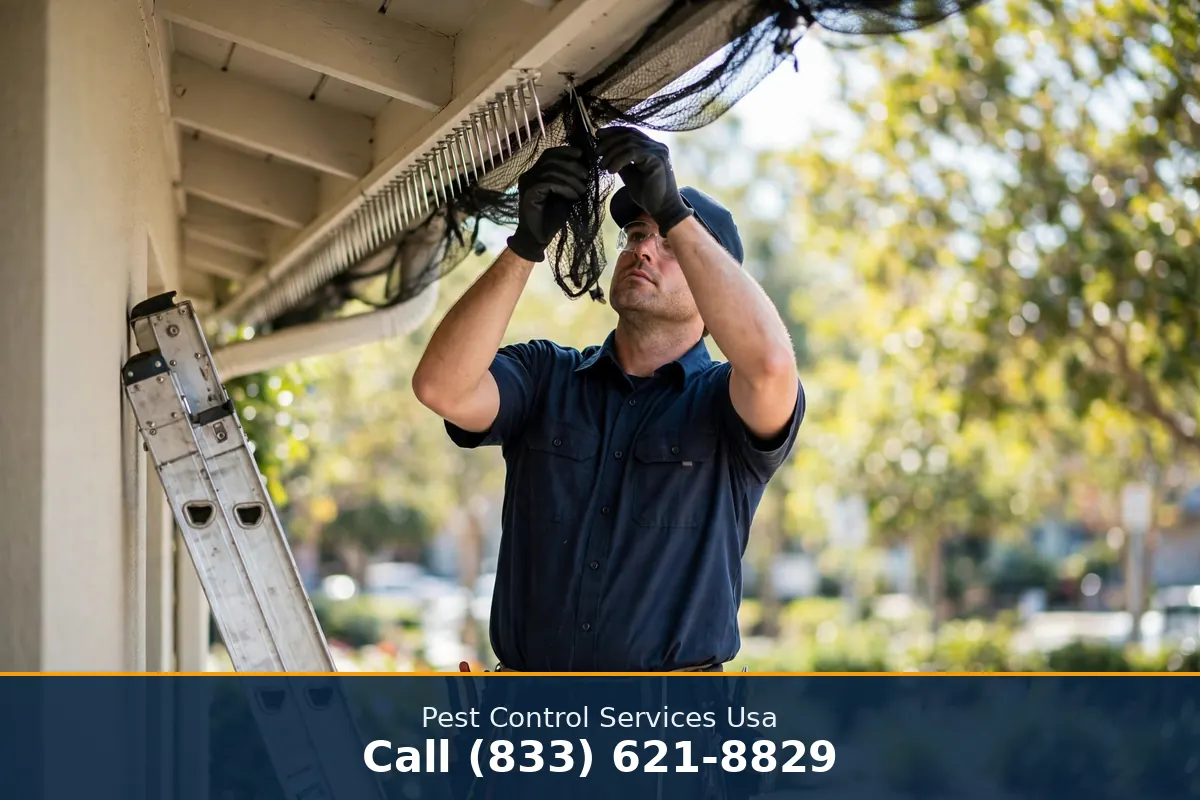
Bird spikes are the workhorse of exclusion. Stainless-steel pins on a flexible base fan out over a ledge, beam, or sign edge so birds cannot land comfortably. They come in widths for narrow pipes and wide parapets, and the base bends to follow curved surfaces. On the right surface they are nearly invisible from the ground, which matters for storefronts and building fronts where appearance counts.
Bird netting covers larger areas that spikes cannot. Heavy-duty knotted polyethylene netting, tensioned on a cable frame, seals off courtyards, loading docks, carports, and the undersides of canopies. The mesh size is chosen for the target species so birds cannot push through or get tangled. A properly tensioned net lasts for years and needs little more than an occasional check.
Screening and mesh guards close the smaller openings. Vent covers, eave screens, and solar panel perimeter guards are cut and fitted on site so there are no gaps for sparrows or pigeons to exploit. We use UV-stable, weather-rated materials throughout, because hardware that degrades in the sun is a short-term fix. Every piece we install is chosen for the surface, the species, and the look of the building.
How the installation process works
It starts with a survey of the building. We map every ledge, opening, and sheltered spot the birds are using or could use. We note the species, since the mesh size and spike width depend on the bird. We also look at how the building is used, because a loading dock that runs all day needs a different approach than a quiet office courtyard. Photos and measurements from the survey drive the material list, so nothing is guessed at on installation day.
Installation day is about fit. Spike strips get cut to length and fastened so there are no gaps at the ends or seams. Netting goes up on a tensioned cable frame with the corners anchored solid. Screens and guards get fitted tight to the opening, sealed at the edges. We work clean and keep the site tidy, and on commercial properties we schedule around your operations so the work does not shut anything down.
After the hardware is up, we walk the whole installation with you and show you what went where and why. Then we schedule maintenance checks. Those checks are simple: look for shifted spikes, loose net tension, or new gaps, and fix them before birds find them. A barrier that gets checked stays a barrier.
What affects the cost of bird exclusion
The linear footage of ledge and the square footage of netted area drive most of the material side of the job. A few parapet runs are a modest job, while a full courtyard net is a bigger one. Access is the other big factor: ground-level work is straightforward, while high facades and steep roofs need lift equipment and more crew time. The type of surface matters too, since fastening to stone, metal, and membrane roofing each take different hardware and techniques.
The building's bird pressure shapes the design. Light pressure might need spikes on the worst ledges only, while heavy pressure calls for a fuller system with netting and screening. If the site also needs cleanup before the hardware goes up, that labor is part of the scope. For a real figure, call (833) 621-8829. We will survey the building and price the actual installation, not a generic package.
How Pest Control Services Usa serves your area
Pest Control Services Usa installs bird exclusion for homeowners, businesses, and property managers across the area. Homes usually need vent screens, eave guards, and solar panel barriers. Warehouses and distribution centers usually need dock netting, parapet spikes, and canopy coverage. Retail centers, restaurants, and office buildings get systems designed around foot traffic and appearance, so the hardware protects the building without changing how it looks.
We start with a survey and a plain explanation of what your building needs and why. If part of the building does not need hardware, we will tell you. To get that survey on the calendar, call (833) 621-8829. We will map the roost sites, lay out the options, and install a system that keeps birds off your building for the long term.
Features
- Stainless-steel bird spikes for ledges and beams
- Tensioned bird netting for courtyards and canopies
- Custom screening for vents, eaves, and gaps
- UV-stable materials built for outdoor exposure
- Color-matched hardware for discreet installation
- Professional installation on roofs and high surfaces
- Maintenance checks to keep barriers working
Benefits
- Physically blocks birds with no chemicals involved
- Stops nesting before it starts, saving cleanup costs
- Discreet hardware that preserves your building's look
- Durable materials that stand up to weather and sun
- One installation protects for years to come
- Keeps gutters, vents, and drains clear of nests
- Preferred by property managers for multi-unit buildings
Frequently asked questions
Will bird spikes hurt the birds?
No. Spikes are blunt-tipped and designed to make landing uncomfortable, not to injure. Birds simply choose an easier spot.
What is the difference between spikes and netting?
Spikes protect narrow landing surfaces like ledges and beams. Netting seals off larger areas like courtyards and docks. Most buildings with real pressure need both.
Does bird netting block sunlight or views?
The mesh is fine and dark-colored, so it is barely noticeable from a distance. Light and air pass through normally.
How long does exclusion hardware last?
Stainless-steel and UV-stable materials hold up for years of outdoor exposure. Our maintenance checks catch anything that shifts before birds exploit it.
Can you install exclusion on any building?
Almost. We fasten to stone, metal, wood, and membrane roofing with the right hardware for each surface. The survey tells us exactly what your building needs.
How much does bird exclusion cost?
It depends on the footage of ledge, the area of netting, the access, and the building surfaces. Call (833) 621-8829 for a figure based on a real survey of your property.