Hornet Control Near Me
Starting price: Call for pricing
Hornets build large papery nests in trees, under eaves, and inside wall voids, and they defend them with painful, repeat stings. Pest Control Services Usa identifies the species, treats the colony directly, and removes the nest where it can be reached safely. One call to (833) 621-8829 takes the danger out of hornet season.
What hornet control is
Hornets are the largest social wasps most homeowners will ever meet. In most of the country that means two species. First, bald-faced hornets: black and white, with a papery gray football-shaped nest hung from trees or eaves. Second, European hornets: large reddish-brown wasps that nest inside tree cavities, wall voids, and hollow fence posts. Both chew wood fiber into paper, and both defend their nests with unusual ferocity.
A disturbed hornet colony is a different experience from a single wasp encounter. Hornets release alarm signals that rally nestmates to defend, and each worker can sting repeatedly. Bald-faced hornets are known for guarding a wide zone around their nest, and European hornets will even strip bark from lilac and birch shrubs to feed on sap. Pest Control Services Usa treats hornets as a safety job first and a pest job second.
Hornet control means locating the nest, confirming the species, and eliminating the colony with a method matched to both. An aerial nest gets a different approach than a cavity nest, and European hornets, which stay active after dark and around porch lights, are scheduled accordingly. When the colony is gone, we remove the physical nest where it is accessible and seal cavity entrances against next year's queens.
When you need it
Call Pest Control Services Usa when you spot a gray, teardrop-shaped paper nest growing under an eave, in a tree, or on a shed. Loud buzzing inside a wall or soffit, hornets bouncing off windows at night near porch lights, and workers stripping bark from shrubs all signal hornet activity. Late summer is peak season, when colonies are largest and most defensive.
- A gray paper nest larger than a softball in a tree or under eaves
- Hornets active around porch lights after dark
- Buzzing or scratching sounds inside walls or soffits
- Bark stripped from lilac, birch, or other ornamental shrubs
- Nests near entry doors, decks, garages, or play areas
- Workers entering a single gap in siding or fascia
Do not wait to see if the nest stays small. Hornet nests grow all season, and a colony that tolerates you in July may not tolerate you in September. If the nest is anywhere people, pets, or customers pass daily, call (833) 621-8829 and keep everyone clear of it.
How the process works
The visit starts with a careful inspection from a safe distance. The technician confirms the species, finds the nest, and maps the flight path and entry points. For cavity nests in walls or soffits, this means listening for activity and watching dusk traffic, since the visible entrance may sit far from the colony itself.
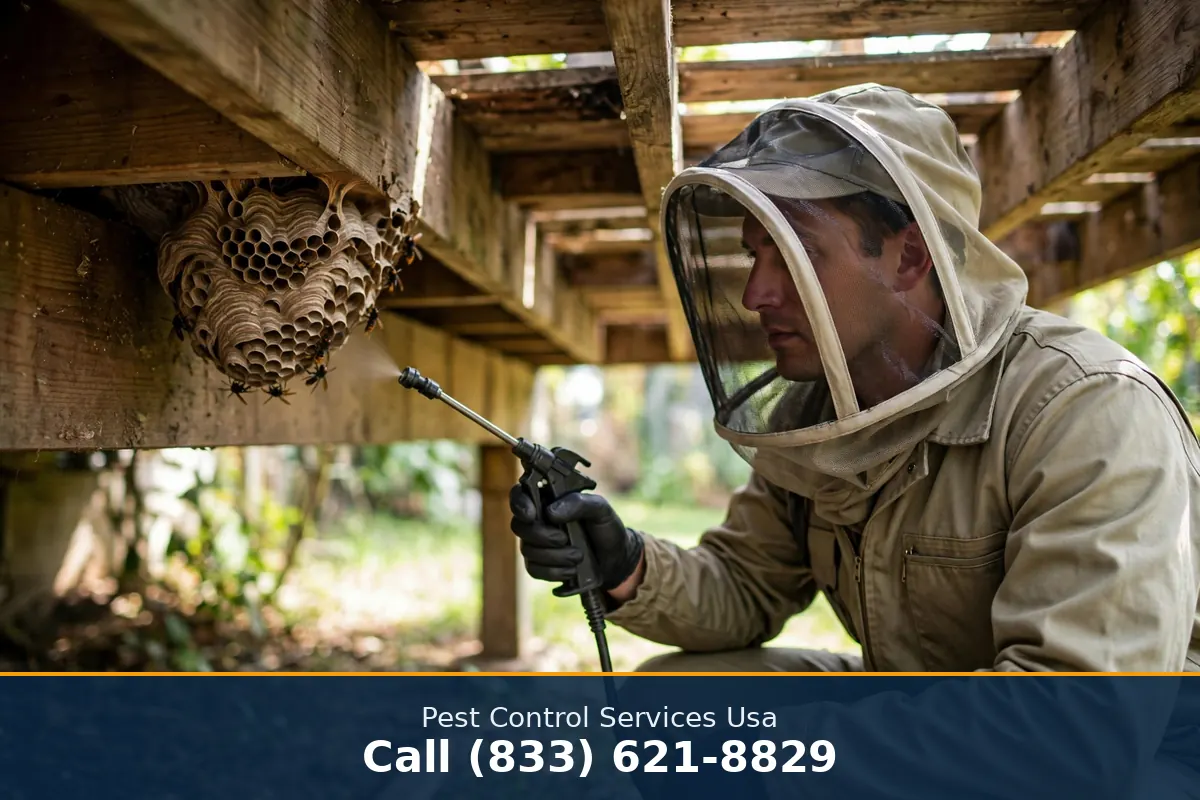
Treatment happens in the evening, when the colony is settled, with the technician in a full protective suit. Product goes directly into the nest entrance or cavity, where it transfers through the colony. Aerial nests may be bagged and removed on the spot after treatment when they are safely reachable; cavity colonies are left to collapse, and then the entrance is sealed.
The follow-up matters as much as the treatment. We check that activity has stopped, remove the nest structure where accessible, and seal the entry with appropriate material. You also get practical advice: managing the porch lighting that draws European hornets at night, and watching the same cavity next spring when new queens scout for nesting sites.
What affects the cost
Nest height and access set the tone for the job. A nest at eye level under a porch eave is straightforward; a nest high in a tree or tucked behind second-story fascia needs ladders, extension poles, and more setup time. Cavity nests inside walls take diagnostic work that exposed nests do not.
Nest size and species change the approach. A mature bald-faced hornet nest can hold hundreds of workers and needs thorough treatment plus physical removal. European hornet colonies in wall voids sometimes need a small access opening, which is repair work beyond the pest treatment itself. Multiple nests on one property are scoped as separate jobs, each with its own plan.
Timing within the season plays a role too. Early-season nests are small and resolve with modest effort. Late-season colonies at full strength need heavier treatment and a careful follow-up, because a partially treated colony stays dangerous.
How we serve your area
Pest Control Services Usa serves homes, apartment communities, offices, restaurants, and schools across our service areas, wherever hornets choose to build. Tree-mounted nests over driveways, eave nests above entry doors, and cavity colonies in soffits are our most common hornet calls. Every technician arrives in protective gear with the products and tools the specific nest requires.
If a hornet nest is growing anywhere near your daily routine, call (833) 621-8829. We will identify it, eliminate it, and take the structure down so the season ends on your terms.
Features
- Species identification: bald-faced versus European hornets
- Late-evening treatments when the colony is at rest
- Full sting-proof protective suits on every visit
- Direct treatment of aerial nests and cavity nests alike
- Physical nest removal after the colony is eliminated
- Exclusion of cavity entrances to block re-nesting
- Height-rated equipment for nests high in trees and eaves
Benefits
- Doorways, eaves, and play areas become safe to use again
- No risk of triggering a swarm with DIY removal attempts
- The nest is gone, not just quieted for a few days
- Night-active European hornets handled with the right timing
- Expert method matched to the exact hornet species
- Sealed cavities stay closed to next season's queens
- Honest guidance on when a nest truly needs treatment
Frequently asked questions
What is the difference between bald-faced and European hornets?
Bald-faced hornets are black and white and build exposed gray paper nests in trees and under eaves. European hornets are larger and reddish-brown, nesting inside cavities like hollow trees and wall voids. They also stay active at night. The species determines the treatment method, which is why identification comes first.
Can hornets sting more than once?
Yes, hornets have smooth stingers and can sting repeatedly. They also release alarm chemicals that bring nestmates to defend, so one sting near a nest can quickly become many.
Should I knock the nest down myself?
No. Striking a nest triggers the colony's defense response, and hornets can chase and sting. Pest Control Services Usa treats the colony first in protective gear. The nest comes down only after activity has stopped.
Are hornets active at night?
European hornets are, and they are strongly drawn to porch and security lights. Bald-faced hornets rest at night. That is why treatments are scheduled for the evening, when the whole colony is home.
Will hornets reuse the same nest next year?
No. The colony dies out in winter except for new queens, who start fresh nests in spring. They may choose the same cavity though. We remove accessible nests and seal entrances to break the cycle.
Do you take the physical nest down after treatment?
Whenever it is safely reachable, yes. Removing the structure keeps other insects from moving in. It also gives you visible confirmation the job is done. Cavity nests inside walls are left to collapse while the entry is sealed.
How do I keep hornets away from my porch lights?
Switch to yellow or motion-sensor lighting where practical. Keep lights off near entry doors at night during peak season. Our technicians will point out the fixtures drawing European hornets during the inspection.