
Rodent Exclusion / Proofing Near Me
Starting price: Call for pricing
Trapping removes the rodents you have today; exclusion keeps new ones from moving in tomorrow. Pest Control Services Usa performs a full-structure inspection, finds every gap a rat or mouse can exploit, and seals each one with chew-proof materials. The result is a building that stays rodent-free because there is simply no way back inside.
What rodent exclusion is
Rodent exclusion is the permanent half of rodent control: finding every opening a rat or mouse can squeeze through and sealing it with materials they cannot chew. A mouse can pass through a gap the size of a dime, while a rat needs only slightly more room. Ordinary caulk and spray foam cannot stop them, because rodents gnaw straight through soft sealants.
Our exclusion service covers the entire building envelope, from the foundation to the roofline. Technicians seal utility penetrations, gaps around pipes and cables, foundation vents, rooflines, soffits, and garage door perimeters. The heavy lifting is done by rodent-rated metals and fitted sweeps. The work is quiet, tidy, and designed to blend with the building's appearance.
Exclusion is a construction-minded service, not a chemical one, and it pairs naturally with trapping. When rodents are already active indoors, we recommend trapping first and sealing second. Closing every exit while animals remain inside would leave them sealed within your walls.
When you need it
Exclusion earns its keep whenever rodents keep coming back. If you have trapped mice before and heard scratching again months later, the original entry points were never closed. It also works as a preventive measure for homes near fields, wooded lots, or waterways, where rodent pressure climbs every autumn.
Look for these clues that your building envelope has openings:
- Gnawed or enlarged holes around pipes, cables, and vents
- Slivers of daylight visible beneath exterior or garage doors
- Rub marks and droppings concentrated along one wall or corner
- Attic insulation that looks tunneled, flattened, or scattered
- Sounds of movement returning after a previous trapping job
New homeowners often choose exclusion right after moving in, before an infestation ever starts. Property managers schedule it between tenants to reset a building's defenses. Either way the principle holds: a sealed building does not need constant re-trapping.
How the process works
Everything begins with a detailed inspection of the structure's exterior and every accessible interior space. The technician documents each opening with notes and photographs, then builds a sealing plan that lists every gap by location and size. You review exactly what will be closed before any work starts.
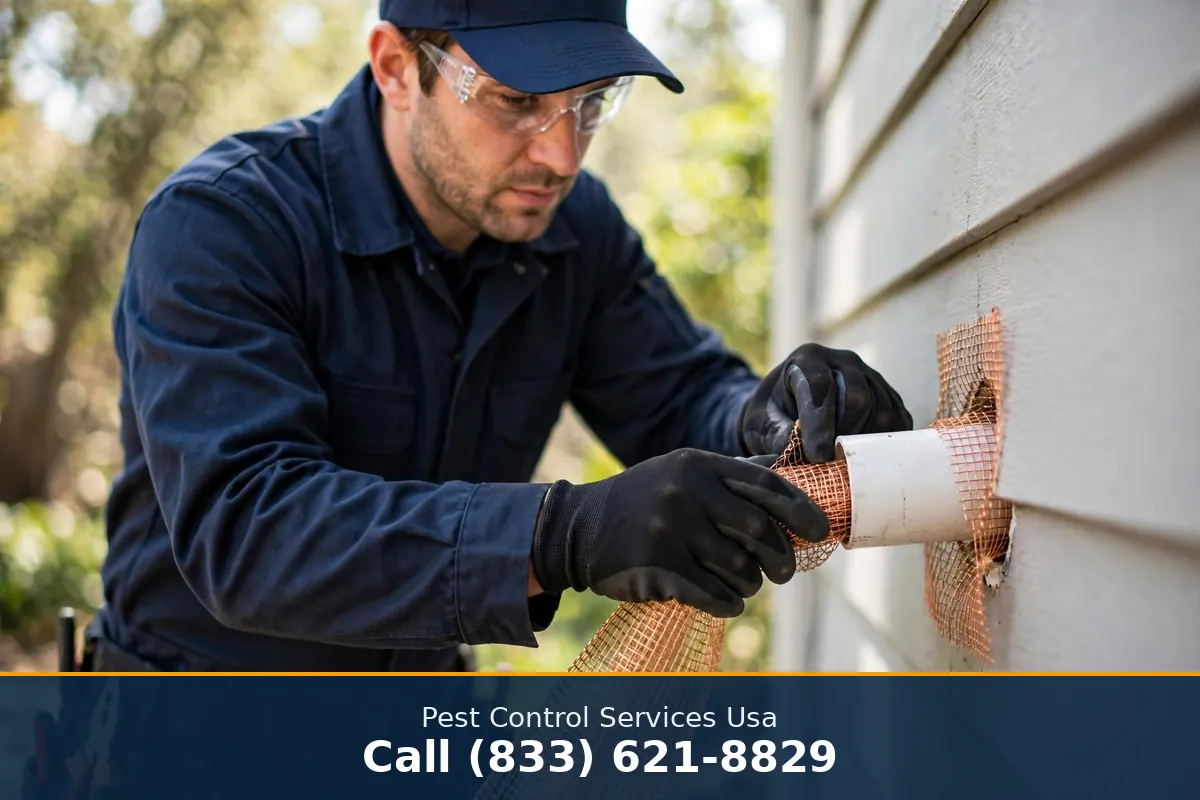
Sealing proceeds from the most heavily used entry points outward. Small gaps are packed with copper mesh and finished to match the surrounding surface. Larger openings receive hardware cloth or sheet metal cut precisely to fit.
Vents get rodent-rated screens that preserve airflow while blocking entry. Doors receive fitted sweeps that close the gap without dragging across the threshold.
After the sealing phase, the technician walks the full perimeter once more to verify nothing was missed. A scheduled follow-up check confirms the seals are holding and no new gaps have appeared. You keep the photographic record, so you can see every opening that was closed and exactly where it was.
What affects the cost
The number and size of entry points drive the quote more than any other factor. A compact home with a handful of gaps needs far less material and labor than a sprawling property with openings at the roofline, foundation, and garage. Building height matters as well: sealing soffits and rooflines on a two-story home takes more time and equipment than ground-level work.
The materials specified for each opening also shape the price, since custom-cut sheet metal and fitted sweeps demand more labor than simple mesh packing. Cluttered crawlspaces and hard-to-reach attics add inspection time.
Properties with prior rodent damage sometimes need small repairs before sealing, such as replacing a chewed vent cover or a rotted door threshold. Those repairs are quoted as part of the same plan.
Buildings with attached garages or enclosed porches add a second envelope to inspect, which extends the visit. Outbuildings included in the same visit are priced on the same per-opening basis. Pairing exclusion with attic cleanup or insulation work expands the scope further. Call (833) 621-8829 for a quote matched to your building's actual condition.
How we serve your area
Pest Control Services Usa performs exclusion work for houses, rental properties, small businesses, and seasonal cabins across our coverage area. Older homes usually need the most attention, because decades of settling, renovations, and utility installations leave a trail of forgotten gaps. Newer construction benefits too, since builder-grade vent covers and stock door seals rarely withstand determined rodents.
Autumn is the busiest season for exclusion, as cooling weather pushes rodents to seek indoor shelter. Scheduling before that seasonal rush means your building is already sealed when pressure peaks.
Rental and commercial properties gain particular value from exclusion. A sealed building means fewer tenant complaints, fewer emergency callouts, and a stronger record of proactive maintenance. Whatever the season, every job finishes the same way: entry points closed, work documented, and seals verified.
The entry points rodents use most
Most rodent entries cluster in a handful of predictable locations. Utility penetrations rank first: wherever pipes, cables, and conduits pass through walls or foundations, the drilled hole is usually larger than the line itself. That leftover ring of space is an open invitation.
Roofline gaps come next, especially where different building materials meet. Soffits, fascia boards, gable vents, and dormer junctions all develop separations as a structure settles and seasons change. Roof rats in particular exploit these high entries, dropping into attics without ever touching the ground.
Ground-level openings are the most numerous. Foundation vents with torn screens, crawlspace access doors that no longer latch, and gaps where siding meets concrete all admit mice. Garage doors are frequent culprits too, since the flexible bottom seal wears down and leaves corners exposed.
Interior chases complete the picture. Pipe runs, ductwork, and wiring channels create hidden highways between floors and rooms. Sealing these interior pathways matters because a mouse that enters through one gap can otherwise roam the entire building.
A thorough exclusion inspection covers all four zones systematically. The resulting seal plan typically surprises owners, who rarely realize how many openings their building has. Each one gets closed with the material suited to its size and exposure.
Features
- Full interior and exterior inspection for rodent entry points
- Sealing with copper mesh, hardware cloth, and sheet metal
- Door sweep and garage seal upgrades where gaps exist
- Roofline, soffit, and vent screening with rodent-rated covers
- Foundation crack and utility penetration sealing
- Photo-documented record of every opening that was sealed
- Follow-up check to confirm all seals are holding
Benefits
- Stops repeat infestations at the source instead of endless re-trapping
- Protects insulation, wiring, and ductwork from gnawing damage
- Lowers contamination risk in pantries, kitchens, and storage areas
- Reduces the need for future trap-and-remove service calls
- Closes winter drafts at the same time as rodent gaps
- Uses durable materials that outlast foam and caulk alone
- Works for homes, rentals, businesses, cabins, and outbuildings
Frequently asked questions
Isn't trapping enough to solve a rodent problem?
Traps clear out the rodents inside, but not the gaps they used to enter. New rodents follow the same routes. Exclusion closes those routes, which makes the fix last.
How small a gap can a mouse really fit through?
About the diameter of a dime — roughly a quarter inch — and rats need only slightly more. That is why a careful inspection matters more than a glance around the foundation.
What materials do you use to seal entry points?
We seal with copper mesh, hardware cloth, sheet metal, and fitted door sweeps — all chew-proof. We avoid foam or caulk alone, since rodents gnaw through both.
Will the sealing work look unsightly?
The work is designed to blend in, with materials cut to fit and finished to match. Most customers never notice the seals unless we point them out.
Do you seal from the inside, the outside, or both?
Primarily the exterior, where rodents attempt entry. Interior sealing covers pipe chases and utility lines. The inspection determines the right combination.
Should exclusion come before or after trapping?
After, when rodents are active inside. Trapping first removes the current population; sealing then keeps the next one out. Sealing first would trap rodents inside your walls.