Wasp Nest Removal Near Me
Starting price: Call for pricing
Wasps build nests in eaves, attics, sheds, decks, and sometimes right in the ground — and they defend those nests aggressively. Pest Control Services Usa removes active nests with professional equipment and treats the area so foragers do not return. You get your yard and entryways back without risking a sting.
What Wasp Nest Removal Is
Wasp nest removal is the safe elimination of an active wasp, yellow jacket, or hornet nest from your property. It covers the nests people actually encounter: papery umbrellas under eaves, gray football-shaped nests in trees and shrubs, and hidden colonies inside wall voids or underground.
Paper wasps build open-comb nests under eaves, deck rails, and play equipment. Yellow jackets nest in the ground, in wall voids, and in hollow landscape timbers, and they are the most likely to sting unprovoked. Bald-faced hornets hang large enclosed nests from branches and high eaves and defend them fiercely.
All three become more aggressive as summer wears on. Colonies grow through the season, and by late summer a single nest can hold hundreds of defensive workers with little patience for anyone nearby.
Pest Control Services Usa technicians identify the species first, because the nest type decides the method. A ground nest, an eave nest, and a wall-void nest are three different jobs with three different safety plans.
The service includes treatment of the active colony, physical removal of the nest, residual treatment at the site, and a follow-up check. It is not a can of spray and a hope; it is a planned operation with protective equipment and the right products for the nest type.
When You Need It
- You can see a papery nest under an eave, deck, shed roof, or porch ceiling.
- Wasps stream in and out of a hole in siding, a soffit gap, or a spot in the lawn.
- Wasp traffic spikes around trash cans, grills, or outdoor dining areas.
- A nest sits near a door, walkway, deck, or children's play area.
- Someone in the household is allergic to stings, which makes any nearby nest urgent.
- You disturb a ground nest while mowing and get chased, a classic yellow jacket encounter.
- A nest reappears where one sat last season, since queens often reuse successful spots.
- Outdoor events, from cookouts to weddings, are planned where wasps are active.
Do not wait on a nest near daily foot traffic. Colonies only get larger and more defensive as the season progresses, and a small nest in June becomes a serious hazard by August.
Nests tucked inside sheds, playhouses, and boat covers are easy to miss until someone opens the door. A seasonal check of these quiet structures catches nests while they are still small.
How the Process Works
Call (833) 621-8829 and describe what you are seeing. The technician will ask where the nest is, how large it looks, and how much wasp traffic you notice. That shapes the plan before anyone arrives.
On site, the technician inspects from a safe distance first. Species identification matters: paper wasps, yellow jackets, and hornets behave differently, and ground nests demand different precautions than aerial ones.
Timing is deliberate. Treatments happen in the evening or early morning, when foragers have returned and the colony is settled inside the nest. Treating at midday misses half the wasps and leaves angry survivors.
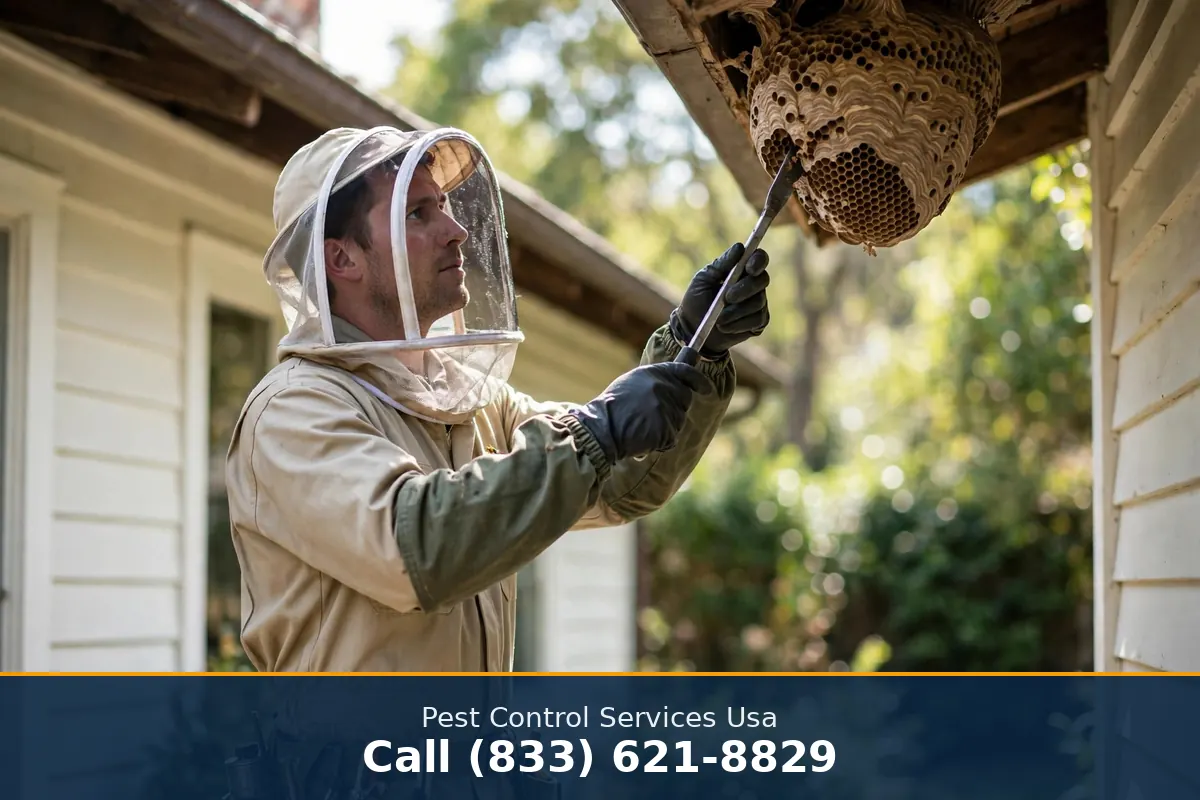
The technician works in full protective gear. The nest entrance receives a targeted treatment that reaches deep into the colony, using products and equipment chosen for that nest type. Wall-void and ground nests get methods that drive the treatment where the colony actually lives.
After activity stops, the nest comes down. Aerial nests are cut away, bagged, and removed. Ground nest entrances are treated and closed. Accessible wall-void nests are extracted where possible so dead insects and nest material do not linger inside the structure.
If the nest sits inside a wall void, the technician may use a small inspection scope to locate the colony before treating. This avoids opening the wall blindly and keeps the treatment where it belongs.
The site then gets a residual treatment. This discourages foragers from returning and makes the spot less attractive to next season's queens scouting for nest sites.
A follow-up visit confirms the colony is gone. The technician checks for satellite nests nearby, because large properties sometimes host more than one, and re-checks the treated site for renewed activity.
You receive clear aftercare notes: what was done, what to watch for, and when the area is safe to use normally again.
What Affects the Cost
Location drives the job more than anything. A small nest under a low eave is straightforward. A nest twenty feet up, inside a wall void, or deep in a shrub takes more equipment, time, and care.
Nest size and species matter. A young paper wasp nest with a dozen workers is a quick visit. A mature hornet nest or an aggressive yellow jacket colony demands heavier precautions and sometimes a return trip.
The number of nests counts. One nest is one job; a property with nests in the shed, the playset, and the ground is a bigger project.
Access conditions add labor. Steep roofs, dense landscaping, and nests behind stored items all slow safe removal.
Timing plays a role as well. A scheduled visit during the week is routine; an urgent nest by a doorway with an allergic resident gets priority handling.
For an exact quote, call (833) 621-8829. The technician assesses the nest firsthand, so you know the full scope before work begins.
How We Serve Your Area
Pest Control Services Usa removes wasp nests from homes, yards, and businesses across the area. Residential calls center on eaves, decks, sheds, and play areas. Commercial calls come from restaurants with patios, warehouses with dock doors, and properties where foot traffic passes nesting spots.
Technicians carry the protective gear and application equipment for every nest type, from ground colonies to high aerial nests. There is no improvising with a ladder and a hardware-store can.
Safety around people and pets guides every step. Treatment zones are explained before work starts, and you will know exactly when the area is clear to use.
If a nest is making part of your property unusable, call (833) 621-8829. Pest Control Services Usa will neutralize the colony, remove the nest, and give you the yard back.
Features
- Positive identification of wasps, yellow jackets, or hornets before treatment
- Nest location and size assessment, including hidden and ground nests
- Protective-equipment treatment applied when wasps are least active
- Physical nest removal after the colony is neutralized
- Residual treatment at the nest site to stop foragers returning
- Inspection of nearby eaves, sheds, and play areas for satellite nests
- Return check to verify the colony is fully eliminated
Benefits
- No risk of stings from a DIY attempt gone wrong
- Entryways, decks, and play areas usable again
- The whole colony handled, not just the wasps you can see
- Less chance of a new nest in the same spot
- Peace of mind during late summer when wasps turn aggressive
- Outdoor events and cookouts without uninvited guests
- Clear advice on what attracted the nest in the first place
Frequently asked questions
Can I remove a wasp nest myself?
It is risky. Disturbed wasps defend the nest in large numbers, and store-bought sprays often miss the colony inside. A professional treats the nest when wasps are calm and removes it with the right gear.
When are wasps most aggressive?
Late summer and early fall, when colonies are largest and natural food runs short. That is when most stings happen around homes.
What about a nest in the ground?
Yellow jackets often nest underground, and those are the easiest to step on by accident. We treat ground nests with methods made for them and mark the area so nobody walks into it.
How long until the wasps are gone?
Most colonies quiet down soon after treatment, and we remove the nest once activity stops. A follow-up visit confirms no survivors or satellite nests.
Will wasps rebuild in the same spot?
They sometimes try. Residual treatment at the site and sealing the void make the spot far less inviting next season.
How much does wasp nest removal cost?
It depends on the nest location, size, and species, plus how easy the site is to reach. Call (833) 621-8829 and a technician will quote the job after seeing the nest.
What should I do if someone is stung?
Move away from the nest calmly, clean the sting, and watch for signs of allergy. Anyone with trouble breathing needs emergency help right away.